E. W. Marland
Killers of the Flower MoonE. W. Marland was an oilman whose rise from poverty to spectacular wealth made him a leading figure in the Osage oil boom. He discovered the highly productive Burbank field, joined the magnates who competed for Osage leases, and helped finance Warren Harding’s presidential campaign. His career also supplied a striking reversal: the man who built a palatial mansion from oil wealth later could not afford its lighting bill and left it behind.
From poverty to the Burbank field
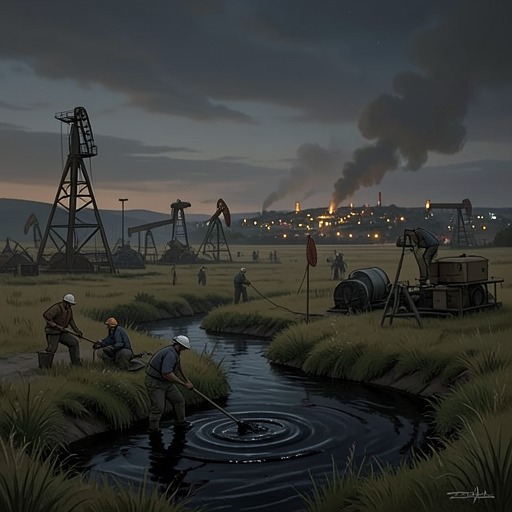
Marland’s oil career began far from the fortunes he would later command. He had once been so poor that he could not afford train fare. In 1920, he discovered the Burbank field, described as one of the highest-producing oil fields in the United States. A new well there generated 680 barrels during its first twenty-four hours, a measure of the scale of the find and of the speed with which drilling could transform a wildcatter’s prospects.
The discovery belonged to a wider oil rush whose eruptions could be both dangerous and spectacular. In 1917, Frank Phillips and his workers were drilling on Lot 185 when the derrick began to tremble. The ground opened and a column of oil shot into the air. Marland’s Burbank discovery came three years later, as new finds continued to exceed earlier ones. The book places his success within that accelerating boom, where oil beneath the prairie could turn precarious ventures into fortunes almost overnight.
Auctions and political influence
Marland was among the oil barons who arrived in Pawhuska roughly every three months for auctions of Osage leases overseen by the United States Department of the Interior. The auctions had begun in 1912, and only part of the reservation’s underground oil resources had been opened to drilling. A typical lease covered 160 acres, but competition drove bids sharply upward. By 1923, one lease had sold for nearly $2 million, while the total collected at a single auction approached $14 million.
These gatherings joined local mineral wealth to a larger contest for economic power. Marland came with other major operators, including Harry Sinclair, Bill Skelly, and Frank Phillips. They studied geological maps and gathered intelligence from employees sent to assess the ground and the competition. The most valuable leases drew the magnates’ attention after a lunch break, when the crowd’s gaze turned toward men whose influence rivaled that of earlier railroad and steel barons. Marland was not simply a discoverer of oil: he was part of a powerful industry increasingly able to shape events beyond the lease grounds.
In 1920, Marland, Sinclair, and other oilmen helped finance Warren Harding’s successful presidential bid. One Oklahoma oilman told a friend that Harding’s nomination had cost him and his interests $1 million. With Harding in the White House, the industry sought access to valuable government oil reserves. Sinclair funneled more than $200,000 to the new secretary of the interior through a bogus company, while another oilman sent the secretary $100,000 in a black bag. The book describes this political landscape as one in which oil wealth could be converted into influence over public resources; Marland’s documented role was in financing Harding’s campaign.
Building as a declaration of wealth
Marland’s fortune took architectural form in Ponca City. He first built a twenty-two-room mansion, then abandoned it for a still larger residence modeled on the fourteenth-century Palazzo Davanzati in Florence. The second house had fifty-five rooms, including a ballroom with a gold-leaf ceiling and Waterford crystal chandeliers. It contained twelve bathrooms, seven fireplaces, three kitchens, and an elevator lined with buffalo skin. Outside were a swimming pool, polo fields, a golf course, and five lakes with islands.
The scale of the residence made Marland a vivid counterpoint to the public stories about Osage spending. Newspapers and magazines portrayed Osage wealth as improvidence, while often overlooking skillful investment and the cultural meanings of generosity and display. During the same era, Marland’s own building project was an extravagant expression of wealth. Asked about his excess, he replied, “To me, the purpose of money was to buy, and to build. And that’s what I’ve done. And if that’s what they mean, then I’m guilty.” His answer made no apology for accumulation or display; it cast building itself as a purpose of money.
Collapse and political aftermath
Marland’s confidence in wealth proved temporary. Within a few years, he was so broke that he could not pay the lighting bill and had to vacate the mansion. After a period in politics, he tried to find another gusher but failed. His architect later recalled seeing him sitting on a nail keg northeast of town, wearing a raincoat and rain hat as men worked a portable drilling rig nearby. The remembered scene reverses the grand house’s image: the former magnate, reduced to waiting beside a small rig in the rain, could not command another discovery into existence.
His name also appears in the account of Oklahoma’s political corruption. In November 1923, Governor Jack C. Walton was impeached and removed from office, in part for abusing pardons and paroles and in part for receiving illicit contributions from Marland that were used to build a lavish home. The episode links oil money not only to private mansions and lease auctions, but also to the vulnerabilities of state government. It does not make Marland the central figure in the Osage murder investigations; rather, his career helps show the broader setting in which immense oil revenues, concentrated influence, and compromised public institutions coexisted.
Significance in the oil-boom narrative
Marland’s rise and fall give the oil boom a personal scale without making its rewards appear secure or evenly shared. His Burbank discovery demonstrates how rapidly a successful well could elevate a once-impoverished wildcatter, while his participation in the lease-and-campaign world shows how private fortunes could acquire political reach. The opulent mansion made wealth visible as an assertion of taste and power; its abandonment, followed by the failed search for another gusher, made that power look contingent.
The contrast also sharpens the book’s account of wealth and its public interpretation. Osage prosperity attracted hostile scrutiny and stereotypes, even as white oilmen built vast fortunes and conspicuous estates of their own. Marland’s own excess, followed by his destitution, complicates any simple division between prudent outsiders and supposedly reckless Osage. His story is one of spectacular extraction and unstable fortune, set against a system in which oil wealth could enrich individuals, shape politics, and leave the people whose reservation held the resource exposed to exploitation.